
 Apple Podcasts

 Spotify

 Youtube Music

 Amazon Music
Changing Perspectives: Diversity, Hybrid Homeschooling & Banned Books with Chris Linder (Homeschool Remix)
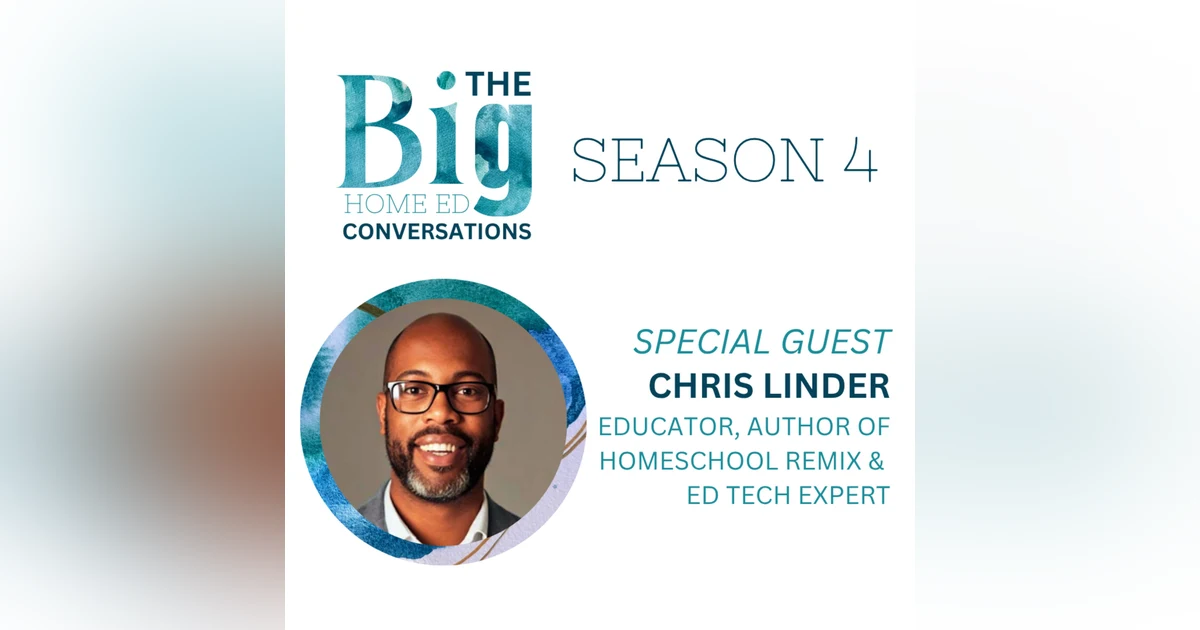

In this powerful episode of the Big Home Ed Conversations Podcast, Kelly and Ashley sit down with Atlanta-based educator, tech specialist, and author Chris Linder—founder of Homeschool Remix—to dig deep into what real diversity and inclusion can look like in home education.
Chris brings a wealth of lived experience, working with all families, but especially Black, Brown, Indigenous, and marginalized families to create flexible, hybrid homeschooling solutions that fit real life—not just the “ideal” often seen online.
Together, we explore why representation in education matters, how to actively include all voices, and the practical barriers many families face in both the UK and US.
This episode covers:
- Chris’s unique journey from radio DJ to teacher, tech expert, and home education advocate.
- What “hybrid homeschooling” really means—and why it’s a lifeline for diverse and working families.
- The invisible barriers and stigmas that keep home education feeling out of reach for many.
- Why representation and critical thinking are essential—at home and in the curriculum.
- The chilling reality of banned books, whitewashing, and whose stories get told in schools.
- How to start tough conversations about race, privilege, ableism, and identity with your kids.
- Practical, honest advice for making home education accessible (even on a tight budget).
- The “folding chair” philosophy: if there’s no seat at the table, bring your own—and build community.
Plus: Why critical thinking—not just travel—is the antidote to prejudice.
Book recommendations for building empathy and perspective at home:
Our recommendation this week is Ghost by Jason Reynolds - get it here from World of Books.
We’re recommending Ghost by Jason Reynolds to accompany this episode because it’s a powerful, accessible novel that tackles themes of race, poverty, resilience, and belonging through the eyes of a young Black boy navigating life’s challenges. Ghost’s story offers a window into experiences often underrepresented in mainstream curricula, making it a brilliant conversation starter for families wanting to build empathy, discuss diversity, and see the world from a different perspective. It’s an engaging, fast-paced read that encourages critical thinking, compassion, and honest conversations about what it means to find your place in the world—perfect for the heart of today’s discussion.
How to join Chris’s “Seat Squad” community for ongoing support: Head to www.homeschoolremix.com to grab Chris’s book, 'Homeschool Remix' and join his community.
Listener invitation: We want your voices! Have you faced barriers, prejudice, or found creative ways to make home education work for your family? Share your story or question with us on Instagram or TikTok @bighomeedpodcast, or visit our blog at offroadingmotherhood.co.uk/blog to join the conversation. We’d love to feature your lived experience in a future episode.
0:00 There was always supplemental home learning going on, going back generations. This and maybe Gen. X are the first generation that really puts 100% of the responsibility of teaching kids in the hands of the state, which I think is a mistake. But if you look at the way our grandparents were and our great grandparents, they, they all, you know, learned a little bit at home, learned a little bit at school. And that's how that's how culture gets passed down. Hello everybody, welcome to another episode of the big Home Med conversations.
0:53 You are listening to Kelly Rick. I'm a home Med mum of two, founder of Off roading motherhood and a qualified mindset coach. I work with families who are transitioning from mainstream schooling into home education and I'm joined by my lovely Co host Ashley Venario. So she's a fellow home Med mum of three and a former primary teacher. We created the Big Home Med Conversations podcast with what began as honest, heartfelt talks around her coffee table and has grown into a space where hundreds of listeners now TuneIn real, unfiltered conversations about mindset, behaviour, challenges, educational philosophies and the often very emotional journey of alternative education. So we aim to cut through the noise and focus on what really matters to us as home educating families. So offering you some clarity, some confidence and community in every episode.
1:36 As part of our Changing Perspective series, we're joined this week by Chris Linda. He's a fantastic guy who lives over in Atlanta and essentially I met him when I was reaching out to people asking them to offer me some insight into the experiences of home educators from sort of various diverse backgrounds. He is working in Atlanta to support diverse families who are really keen to home educate and support their children more outside of their schooling. So whether that's in conjunction with school as a kind of a more flexi schooling kind of basis a bit in a bit out or as home educating families or home schooling families as it is referred to in the US. And essentially he he's joining us today to discuss the really quite important conversations around othering in terms of race and recognising that there are challenges that are being faced by different communities, diverse communities who obviously would maybe want to home educate their children, but would experience more prejudice in doing so. We're experiencing so much whitewashing in education. We're experiencing banned books and libraries pre emptively removing books from shelves to kind of thinking that maybe one day they'll be considered a bit too out there in terms of opinions.
2:49 We're seeing young people from all backgrounds having a limited opportunity to understand the individuals that have influenced amazing things in our human backgrounds and all of the different people who play a part in making it what it is today. And ultimately what this can do is ensure that our children are raised with set opinions of people from different backgrounds, people from different ethnicities or religions. And ultimately stop them from having the critical thinking skills that they need to be able to go out into the world and to make a difference and have some compassion and empathy for all individuals and to respect the opinions of all individuals as well. Now, one of the things that I've felt myself feeling very passionate about in recent months is just ensuring that my children do not grow up in a bubble.
3:36 And whilst our community is reasonably diverse with lots of people from various different backgrounds, religions, etcetera. The difficulty I've found is in actually making sure that they really, actually understand that those those people have different beliefs and different religions and different ideas. They eat different foods, they have come from different places, speak different languages and that these amazing things about them are things that we should be curious about and, and asking questions about and getting to know even more. And sometimes that can be really tricky to ensure that our children do get that really diverse understanding and, and to build that curiosity about their fellow fellow man. So what I really want to offer you guys as part of this series and what me and Ashley have worked really hard to do is to bring you a series of conversations with people from so many different backgrounds who will hopefully help you to bridge these conversations with your kids. So without any further ado, let's get stuck in. This is the interview that we've just finished with Chris and we hope that you find it as eye opening as we did. Chris, I'm so excited to have you on today. We have been chatting a little bit in advance of this conversation and I had such a great time with Chris. Honestly, I think we ended up chatting for like 2 hours. The first time we spoke didn't really it went on forever and we were like, I really shouldn't let you get on with your life. What is this poor guy is is over
5:07 in America. So he is based in Atlanta and he is an an educator. He's he understands technology. He's done an awful lot of work in those both of those sectors and essentially now works with diverse families to help them kind of explore kind of techniques solutions for full or part time home home schooling. As obviously in America, it's referred to as homeschooling. In the UK, we call it home education. In this conversation, we mean the best same thing. So please don't jump down our necks about it. So give us a break on this one, people. And essentially what we're going to chat to Chris about today is really the the challenges that diverse families are facing when trying to embrace home education. How we as as a community need to be really conscious of ensuring that our education is really, really diverse as well and that we are taking in lots of different perspectives. So I'm really excited about today's chat. We've already had a really good chat about this already, so I know it's going to be great.
6:01 But tell us a bit more about you, Chris. How have you ended up kind of falling into education and loving, loving doing stuff like that? What's what's been the draw for you? Well, my, my background is, is really varied. I started out in elementary school. I went to a small charter school where we worked individually at our own pace in little booklets and little cubicles. So I really didn't see the inside of a traditional classroom until I went to middle school and high school. So I really approached education as a younger kid from this independent standpoint. And then when I went on to high school, I had great teachers who really taught me how to express myself through writing, how to think critically.
6:54 And so I was well prepared when I went into college. And I actually went into radio broadcasting because my high school had a radio station. So I became ADJ for a while. Yeah. I I thought that that was what I wanted to be for the rest of my life. But I soon realized there's not really much money in that. So I, I was on the air in my mid 20s and I got a book. I was really bored. I had this wanderlust and I thought, well, what, what can I do to like leave the country and, and still make some money and then, you know, decide what I want to do when I come back. I got a book called Work Your Way around the World and describe all the jobs you can do if you, you know, just leave the confines of your country and, and go off to Asia and teach English or go off to South America and pick fruit. And I was like, well, I don't really want to work in the field because I'm lazy and, but I can speak. So maybe I'll go to I, I moved to South Korea and I taught English and a Hagwan, a little language institute. And it more than anything that really excited me about, about education.
8:13 That really got me excited about actually dealing with students at a one-on-one level. These are students who were in high school and college, but before their their classes during the day, they would come to our language institution and, and learn English. And then they would come back sometimes at 7:00 or 8:00 at night and take more classes. And, and they were really invested in learning English because obviously it's a lingua franca. It's a, you know, something that would help them in their careers in the future, but also because they wanted to be able to learn the learn the slang and the idioms from from Hollywood movies that were, you know, that were becoming big over there.
8:59 So, but when I came back to the states, I had that teaching bug. So I got my degree in instructional technology. And even though I would back into radio, I still kind of substitute taught school in my spare time. And eventually I actually became a full time high school teacher. I, I married my wife who was an elementary school teacher and she started writing books about, about the Common Core, the standards that were that were being implemented at the time and other professional development books for teachers. So it kind of I realized after a couple of years of teaching high school world literature that I was a better, I was a better teacher than I was a babysitter like, which meant that classroom management was not was not a skill that I had really, really picked up on. So it was a lot easier to, I guess, teach high schoolers in Korea that it was to teach high schoolers in Atlanta. So, so I got out of teaching, got back into basically back into media, back into tech and work on worked on IT systems and, and things like that.
10:19 And long story even longer, I eventually my wife passed away. And sorry to hear that after, after a few years after COVID, I was looking at ways of trying to fill in the gaps between what my what my children weren't getting in school. And especially when COVID hit, there was a lot of remote learning. And I, we have two kids, one kind of thrived in learning at home and one needed that classroom interaction. So I realized that there's no one-size-fits-all magic bullet for, for parents who are trying to teach their kids at home or trying to teach their kids through traditional schooling. So I, I realized that there were a lot of things that my kids weren't getting in school, but maybe I didn't have all the where even as a teacher, I didn't have all the the wherewithals to teach them full time through home learning. So I came, I didn't really invent it, but I, I tried to work out a strategy to where you could use hybrid homeschooling to, to fill in those gaps.
11:44 Yeah, to provide a well-rounded opportunity for them. So they've got other other perspectives and ideas. Yeah, exactly, Exactly. Yeah. So, yeah, diversity is a, is a very strong proponent because I work with a lot of families from marginalized communities, Black, brown, Indigenous people. It's, it's really all about representation and diversity in both the, the subject and topics that that they're studying and in the families themselves. And, and that's something that's not being really, really addressed in public schools now. In fact, it's it's less so now than it was even 10 years ago. Yeah, I think that's, that's a bit, a bit scary as well that kind of concept that it's becoming lesser and I think we can probably assume who may be somewhat responsible for that. We can get on to the politics bashing later. But I, I suspect that like what can be really difficult, especially as you like in the home education community. So in the UK, typically the concept of doing a bit of both is, is quite common.
12:53 I think most families will have the children in school and we'll be sending them off to extracurriculars. We'll be paying for extra for tutors or online classes and things around it. Like there's an awful lot of that going on. But there is also then an awful lot of people who are starting to look into what's termed as flexi schooling here, where children will be partially in school, partially out of school. So like a couple of days a week in, couple of days a week out. The schools are quite resistant to this because obviously they teach a set curriculum and it means that those children are potentially missing things on the days that they're not in. And they're having to try and like bridge that gap somehow and work with the families to make sure they're covering those things on their days that they're not in school, etcetera. But ultimately the, the concept of schooling here is that it, home education is possibly one of the rarest options in the UK for education, but it is growing very fast. And there's an awful lot of people starting to realize that it's a valid option, that it's legal, that it's an opportunity to provide a better, well-rounded perspective on education for our children.
13:48 Like, for example, I just went through the curriculum for year three that my son's just finished to just sort of see where we're at, to see where what he's ticked off. And we've ticked 95% of the boxes without even trying. And ultimately, I know that beyond that, the subject matter that we have covered, the places we've been, the conversations we've had, the books we've read are way above and beyond the level that would be expected of him at his age. And it gives us an opportunity to really dive into lots of different conversations. However, it does also call into question when you home educate this concept of as an individual, I have got my lived experience, I have got my perspectives, I've got the things I know about to teach about or to tell them about. And I've got my, my own kind of passions and interests that I will obviously naturally lean towards and say, well, they, and that what can end up happening is that in a home educating environment, we tend to get quite focused in on what we know and what we believe.
14:42 And without an opportunity to really experience other cultures and diverse inputs, we may struggle to actually help our children understand them at all. And this, this is quite scary for me. And it's something that kind of just dawned on me, I guess earlier this year that I was, as they're getting a bit older and I'm able to have slightly more in depth conversations with them. I suppose that's probably why it suddenly comes to the front of my mind. My son's about to turn 9 and I'm very conscious that he's he's coming into his sort of preteen phase. He's going to become an adult in not that long a time at all. And I wanted to make sure that as he does, that he's got a really good perspective and understanding of the world around him. And I think that, like you said, that kind of idea that parents need some support to help them understand how they can better support their kids with this from home is is vital.
15:27 I don't think that any of us have got all the answers. And I'm hoping that, yeah, this this series of victories really going to help them to think. There's actually lots for the people out there that they can lean on to get ideas from. So obviously Chris has got, it's called Homeschool Remix, I believe it's called, is the name of your book. Yes, people can grab that. The name of the book and the name of the framework. Yes. So we'll be referencing that in the description as well, guys. So don't worry, you will be able to go to the link and find that if you're interested in learning more about that from Chris as well in that perspective as well beyond it. But yeah, it's, it's such a tricky thing, isn't it, to, to discuss with our children because sometimes we just, we really don't even know where to start. That's the big thing. Parents don't really know, you know, They don't know where to start.
16:07 They don't feel competent and confident enough in their skills and knowledge to take that step into homeschooling. And there is a stigma attached to homeschooling, especially here in the United States. There's a lot of people who feel that, well, you, you know, you're homeschooling is for the doomsday preppers out in the middle of out in the middle of nowhere who want to, you know, are really strongly religious and want to give their kids a religious education and they don't trust the government and, and so on. And, and there there is that truth to that, to that stereotype. But also I think that we need to look at, we need to look at a couple of things.
16:55 We need to look at the education system and the way it's set up and the reasons why it's set up the way it is. A lot of people say, well, the educational system's broken. We need to do something to fix it. The educational system isn't broken, at least here in the United States. It's actually working exactly as it's designed. It was meant to turn out moderately educated laborers for a labor force. People who could read at a 5th or 6th grade level didn't have to worry about critical thinking, people who could just follow directions. And it's been that way unchanged for, for the most part, unchanged for the last 125 years. The other thing that people that parents especially need to look at is that we have a strong tradition of supplemental home learning as, as African Americans, I, I can look at it from this perspective.
18:01 Slaves, it was illegal for, for enslaved people to, to learn English, to learn to, to read, to learn, you know, science and things like that. So a lot of, in a lot of cases, communities had to basically teach their young kids in secret. And there was always supplemental home learning going on going back generations. You're not just depending on like this is this and maybe Gen. X are the first generation that really puts 100% of the responsibility of teaching kids in the hands of the state, which I think is a mistake. But if you look at the way our grandparents were and our great grandparents, they, they all, you know, learned a little bit at home, learned a little bit at school. And that's how that's how culture gets passed down. So when parents are looking at who's going to teach their kids history about their own culture, they really need to look that that responsibility being on on themselves. And as far as diversity, unfortunately, you know, for whatever reason, we seem to be rolling it backwards. There's less diversity in education. There's less inclusion in education. But I mean, that starts with the family. And even though homeschool remix
19:32 the framework is designed really to benefit kids from diverse families and marginalized communities, most it it's inclusive, not exclusive. It's not for and this, you know, it refers to hybrid homeschooling as a as a whole. It's not just for one kind of person. 11 race of people education is the. Concept of active inclusion, isn't it? I think a lot of. Social models that are coming forth with trying to recognise things like ableism and ageism, et cetera, that all of it really comes from a concept of being actively inclusive to all.
20:13 Instead of it being like this is how it looks and you have to try and wedge yourself in it somehow and supplement and support yourself elsewhere because otherwise it's not going to work trying to understand. Yeah, like it's, it is that concept of assimilation that I think is just. It is starting to wane. I think as people are starting to be more conscious and aware, which is exciting and definitely bodes well for sort of revolutionary change. I think in a lot of communities that we are starting to to be a little bit more sceptical and be a bit more aware that we're not supposed to all be exactly the same. But it's yeah. It's interesting you mentioned about the family learning because when I think about my mom, she was one of eight children.
20:53 She was the youngest. And when she talks about how she learned to read, she learned to read from her siblings. They naturally would read to her and she would be thinking, how are you spelling the OR like where do you see that on the page? And so when she entered school, she already knew how to read. Other kids in her class didn't. But it was something that just she, when I asked her like, oh, did you like take a phonics program? Or was it a workbook? And she's like, no, we just did it as a family. And I just learned because we did it. And then they were quite religious growing up. And so she was also attending a weekly Sunday school. And that was another component that then after that took place and they went to church on Sundays, they would all come home and work together as a family discussing what they learned, discussing how it applies in their household and how they can help to kind of bring that message forth to other people.
21:48 And I think unfortunately or fortunately, depending on. OK, thanks. She she didn't continue that very religious perspective and kind of decided that we would be raised to decide for ourselves and not have it kind of pushed upon us. And so I didn't have that same experience of like a, a Sunday school and family discussions around things growing up. But it, it is interesting because I think that really impacted her and certainly brought her faith, which she still has very strongly to this day, as a very prominent part of her life and, and who she is. So you can kind of see the impact of the family's perspective. It does get to the core of who you can be and influence how you grow and decide to move forth in the world. Yeah.
22:39 I think it's really important for families to realize that education can be a family centered thing as opposed to either a student centered thing thing or a institutionalized thing. If you if you raise your your kid in a family and give give them multiple ways of of getting education, whether it's through traditional school every day, adding in Sunday school lessons on Sundays, adding in a homeschool Co-op meeting on a Saturday, field trips, other experiences like that it it should and all the.
23:20 Things. Yeah, exactly. Travel. It all comes together to give a well-rounded education, and that should be the goal rather than simply saying, oh, school happens between 8:00 and 3:30 and that's where you should learn. All of you know your history, facts and your math and your STEM and so on. Yeah. And I think that kind of concept that school is supposed to provide the whole thing as well. I think more and more these days, parents are going well. They're just, they're not teaching them these functional skills in school. They're not teaching them how to sort out their mortgage. They're not teaching them how to manage their bank account. They're not. They're teaching them how to change a tire. And it's just like, yeah, but that's up to you. But I'd like to caveat that and to defend parents to some degree in the economy as it's been in the past, however many years from 20-30 years really, we have moved into a situation where almost both parents have to have a full time income in order to be able to keep up with the basic like requirements. Like if you're lucky enough to have an income where one of you is earning enough to to somewhat supplement the other so that you've actually got some time at home with your kids, then amazing.
24:24 Like I argue constantly internally and it's something which I think I'm going to have to campaign for in my lifetime, is for the fact that in the UK, children are entitled to an education in school. They're entitled to therefore £8000 a year to be spent on their education in an institution. They're entitled to all exams and qualifications that would come with that, paid for by the government. But if you choose any other path, home education, private education, etcetera, then you officially release any of that funding. Now that comes to you, you don't get any support. And actually as a British citizen, my children deserve that money. They deserve those opportunities. And frankly, as a parent, £16,000 to educate my children would go a heck of a lot further than it does in school. I mean, you think 1 teacher in a room with 3335 children that we're dealing with these days, 4 kids pay their salary for the year.
25:11 The rest of it is lost on infrastructure and the rest of it, right? And it's just shocking how much that money is being wasted and lost. And actually schools are desperately needing more money that they're actually they need even more because it's just everything costs so much more where there's a whole other conversation for a different time. But like, the quality of education cannot increase. Like it can't do more. It's the same here in America and it's, it's so sad. And that's, that's kind of why I devote so much of my time and energy towards marginalized communities because in in so many cases, it's a single parent household or it's both parents working. They don't have the time, money or energy to devote to full time home schooling, but they do realize that they need the benefit of homeschooling and that's why hybrid homeschooling is so important. But it so many people don't realize that here in the states, it differs state by state, but some states offer 4000 or $5000 a year to homeschoolers.
26:12 You know, but there's no, there's no infrastructure of, of educating parents about homeschooling. So a lot of that, you know, they don't even know about that. And then on the opposite side of the coin, you have this movement towards school choice where they're using taxpayer dollars to, to divert towards private charter schools as opposed to public schools. And you can get a voucher to, to maybe have your kid attend this supposedly better private school. What they don't tell you is that the private school can decide whether or not to enroll your student, your child as a student based on whatever factors they come up with. If they don't want to deal with with neurodivergent kids or if they don't want to deal with LGBTQ or, you know, even if you're just not our type of people, you know, they can, they can decide that and, you know, yeah. And that.
27:17 Obviously in private schools as well, they have a lot more freedoms in terms of choice around curriculum in the Uki don't know the same in America, but they don't have to sign the same curriculum. So ultimately you are putting that your children's education again in the hands of other people deciding what you what they think is important for your children to know and the messaging and the like experience of those teachers. And, and yeah, ultimately as well. I think if you've got a child who's maybe got a scholarship program, you see this a lot in sort of movies and stuff like that. They get kids who've got a scholarship program or they've managed to get a grant or whatever and they go to a school that we, we have a class system in today. We have got people who behave how they behave. And we do end up with this prejudice going down through the, the bullying and the experience of that child in that school doesn't mean that it's necessarily very productive for them either. So it all becomes like these barriers to opportunity and information and what should just be like, we should all have access to to these things.
28:10 But I think there's my, my dad always refers to our generation as being very entitled that we kind of expect that we're going to receive like world class education, world class healthcare, that we shouldn't have to pay for these things like why should we pay for them and we should just get them. And to some degree, I think parents have kind of lost sight of the fact that actually, if you want really amazing things, then do you, you do have to try and make them happen yourself sometimes because ultimately it's not all there for the taking. Like I mean unfortunately. That's true, but we do dying like we. Do pay for them. We do pay for these things. We pay our taxes. Yeah, we we do. Our We pay so much in. Taxes that we should be living in a utopia, but we're not, you know, and yeah, there's the responsibility of the parents to say, OK, well, you know, yes, we're not we're not living in a perfect world.
28:55 What do I need to do to teach my kids? What do I need to do to make sure that my kids. You talk about practical life skills. I talk about this in in the book homeschool remix. My daughter, I was driving her to work one day. She was this senior in high school. She worked at fast food place Wendy's. And she asked me, Dad, what's a mortgage? And this is something that I, you know, would have assumed that she'd learned in middle school or in high school or something, you know, you know, But I had to explain to her what a mortgage was. And I realized that they weren't. That was one of those one of those aha moments that I was like, oh, OK, they're in. At least here in America, kids are more prepared to deal with an active shooter than they are with how to balance a checkbook or. With how to get?
29:46 A home loan, you know, we're not teaching the kids in school the things that they need to to learn. But ultimately it. It's on the parents. The parents have to figure out how to teach them financial literacy, how to teach them practical life skills, how to teach them cultural history. Yeah. And I think that we. We are definitely operating within a society that doesn't value family time. It doesn't value downtime. It definitely encourages hustle culture. It definitely expects parents to be working crazy overtime, expects them to be utilizing the breakfast clubs and the after school clubs. They expects them to be ensuring their children attend school or else they won't be successful. They expects them to be put on the all these extracurriculars. Like there's an awful lot of expectation of parents to somehow parent their children whilst also never getting to be with their children and somehow figuring. Out a way to to untie their children from social media when you know in a lot of cases we can't even do it ourselves that's the thing we.
30:47 Can't. Yeah, yeah. It's, it's a very complicated world we live in right now. And I think that ultimately a lot of children are going to be not, I wouldn't say necessarily always suffering for it, but it is ultimately that kind of concept of if they aren't being given enough grounded opportunity to spend time with their caregivers and to learn about the cultures and to to be involved in their communities to see how they can be productive and contribute to that society. Like there's an awful lot of things they're lacking by being kind of shoved into a school environment in the UK, They're expected to be there until they're 18. Now, honestly, they're leaving school as an actual adult adults. Like they're now like, OK, now as opposed to go and contribute somehow. But you know, most of the time they're still expected to just carry on with their education and they just don't even know where to begin.
31:32 And I think I started out around the age of 18 going into the workplace because I just was very disillusioned with education. And I've obviously gone out and I've just worked and I've just just cracked on. But my brain is one of the things which I feel very worried about in our education system is how I got good grades. I got, I got really good grades, A's and B's and things at GCSCI did OK in my A levels. I went off to work. I managed to get a job right away. There's no issues with that at all. I promoted reasonably quickly. I was always able to keep a job and money, et cetera. Things felt good. Like I felt like I'd worked really hard through my schooling, just going off and being successful in the world. However, I was definitely judgmental. I was definitely unaware of other people's lived experiences and why they might be struggling to access the same things as I definitely had prejudices. My my father definitely had some sense of humour issues around things which are completely inappropriate in modern modern PC World that we shouldn't be saying things like that. So there were definitely little, little snipes and jibes and jokes and like opinions that that had obviously woven into my consciousness.
32:31 And ultimately I was very unhappy. I found it very difficult to relate to people. I found it very difficult to not be competitive. I found it very difficult to, to work as part of a team. I, I was, I was very happy working by myself. I could do great things by myself. But if I was expected to work as part of a wider thing, I found it difficult to communicate and to to collaborate. I certainly wasn't thinking for myself. I had no awareness of politics. That sounds awful. Like I'm literally listening these things as just shocking at how disconnected from reality I actually was. And that obviously had a massive knock on effect to my confidence, my happiness, depression, mental health, like my relationships, like actually it really was a massive detriment to me. And it's obviously one of the main reasons why I have decided to home educate my kids because I honestly, genuinely think that I need to have more involvement in the messaging they're receiving.
33:23 But just like opportunities, I want to give them more control. I really don't want them just blindly following whatever information they're given. But what worries me is that when you were given a curriculum and you were told this is what we're learning about and this is what we're going to achieve from A-Z. If that curriculum has not been formed with active inclusion and diversity in mind, that means that you and also with the whole kind of structure that that idea of competitiveness, that aim to try and raise a bunch of labourers to go off and do the work that needs to go and be done. Because I agree, there is an agenda behind our school system and it is doing what it's supposed to do at the end of the day. That's why they're not fixing it. And we have got to start standing up and going, wait a minute, this isn't fair. But ultimately we are dealing with a system that is not working brilliantly for our children.
34:07 It's not got the individuals in mind. It's not got their innovation in mind. It's not got their personal development in mind. Maybe there are, they're starting to try a little bit here and there, but it's ultimately they're they're trying to work against the tide. Like it is very difficult for for teachers to be helping their kids to embrace some of these thoughts and ideals in a world which is definitely going that way. Most people you speak to now will have these ideals and be starting to be like, no, I don't like that messaging. Actually. I don't want my kids to be Uber competitive or whatever. But they're still sending their kids into an environment where that's what they're basically being taught day and night is how you're supposed to be. So they're fighting against it. And I think that we've got to therefore be a like to kind of get into the real nitty gritty of this conversation around whitewashing and banned books and the lack of information.
34:54 We've got to start understanding that schools, home educators, anybody who's got quite fixed beliefs or values are going to find it quite difficult to step outside of that. It takes an awful lot of self work and awareness to notice where you have got prejudice or you have got judgement going on. And if you want, like I I actually do believe that an awful lot the home educating community is doing that work or they said trying to. But every single time I have a conversation with someone about anything to do with this, it makes me go, Oh my goodness, I did not realize that. That's that thought that I'm having is really not OK. Like reading the one about ageism, for example, is making me realize how often I prioritize my adult priorities over my children's priorities. And actually whatever they want from me right now is like, yeah, I know, but this is more important because I'm a grown up and it needs to make money or whatever. Like, and it's like, Oh no, what are they doing? Like it's it's so important to keep making asking these questions.
35:47 But I guess what I'd love for to get into now, Chris, is honestly how terrible it is for the majority of the, the US curriculum, etcetera, to be well, the the the young people who are experiencing AUS curriculum right now, how limited their understanding of diversity is and what they're actually lacking. Like what are they not getting? What are they not understanding? Well, it's. I mean, that's an excellent question. It's such a multifaceted thing. You can look at the lack of diversity in education as an as an ongoing problem, as a problem that's been there since the beginning, of course, yeah.
36:31 And it seemed. To have as people study it, it seems to have gotten a little bit better, but you can't understand that in the way our system is set up. All of our textbooks for the the majority, like 95% of our textbooks are written and developed in Texas. And the main curricula in in high schools, middle schools, elementary schools are developed from a very mainstream point of view. It's rare that diverse communities see themselves reflected in the things that they study, the things that they learn.
37:14 So you're not seeing a lot of Black faces in textbooks, you're not seeing a lot of brown. And more importantly, you're not hearing those stories. You're not studying those stories, Indigenous people, LGBTQ, you're not hearing the stories of those inventors and explorers, Even those authors you know, you'll once in a while you'll study, you'll study Martin Luther King, you'll study Rosa Parks. You may, you know, have a paragraph about Frederick Douglass or maybe Malcolm X, but there are so many more stories that aren't being told in the in your standard textbook and that that affects people from marginalized communities, but also from from mainstream or white communities.
38:10 You know, they're not seeing that diversity, they're not getting that, that representation. So naturally, you know, they think, well, all the most important people were these old white men. These were our founding fathers. Those were the, you know, because that's the, the Eurocentric point of view that that's presented. But I always say that the, the antidote to, to racism, you know, and, and everybody turn up your radios because this is really important. This is, this is how to cure racism. The antidote to racism is travel is going outside your comfort zone and seeing other cultures, seeing other people, seeing other other things. And then it's really hard to, unless you're, you know, really, really doubling down on it.
39:01 It's hard to be a racist after you've went out and seen the world. I think what what? Is important to add to that though, is, is going out and seeing the world is, is one thing. But I remember for example, driving through Sri Lanka when I was probably about 2021, something like that, and seeing these small tribal communities of people who are like very, very small little communities that literally they'd have. The only thing that community did was harvest one particular kind of fruit and sell it at the side of the road that that entire community was based on. They all worked in that area on harvesting that fruit. They all sold it at the side of the road and some of them took it off to bigger markets. And that was that money was then shared to support their community and they, they took care of each other.
39:43 And what is very important to, to remember when you're looking at these situations, there is, is sometimes that actually it almost builds on racism as well, because it creates this sense of superiority. And like with all of our technology and all of our big buildings and all of our healthcare and our access to education, all these things like that. Without support to think critically in these situations or to to notice the beauty or to recognize the simplicity of that life and how lovely that is that actually they're they're getting to just be with the real natural instincts of being human to live on the earth to to forage and feed their families to to make just enough money to to get what their community needs to keep going And that their limitation.
40:26 Well, probably their limited access to disease and hardship and horror from the world around and like there's an awful lot of beauty there. But without having that really critical conversation and to to be able to actually see things from a different perspective, to have the skill to be able to do that. A child might look at that and just think, oh gosh, that looks awful. Like where's their Xbox? Where's their school? Like where's all their like amazing suites and stuff? Sure. We just. Look at it through through our lens. Yeah, like the, the, the. Experience that they've had and and what they are used to and they think that that person is lacking, but you put you hit the nail. On the head with critical thinking, if you don't enable your critical thinking switch to turn on when you're, when you're out exploring. And and that's, that's the skill that you have to teach that we have to teach our kids more than anything, it's, it's about critical thinking, yeah.
41:23 And asking our children. To challenge things because ultimately they will asking questions. Yeah, because I think a lot. Of the time if if a child is being taught a curriculum and if they try to deviate from it, they're told Nate we're learning about this right now and they ask a question to challenge the teacher and they're told no, we're not talking about that in class like I'll talk to you about it later or whatever it might be then there's there's a lot of these moments that we're basically asking children to not ask questions and to I know I sound like I'm being really like hard and harsh right now no, but I mean that's. That's what the educational systems is based on. We're we're teaching them not to ask questions, but to follow directions. Just do what I say.
42:05 Just here's the information that you need. You don't need to think further into it. You don't need to think critically about it. Yeah. Right. Just just learn this, pass the test, and then you can learn some more in your own time if you want to go into it in any more. Depth and obviously you have no free. Time so clearly you're not going to do that in your free time because you'd rather play a video game, right. But I think this is what we have to be really conscious of. And I think, you know, when I speak to my kids about stuff and I I I'm reading some books with them at the minute in preparation for this series. And there have been some very hard hitting moments and bits that have made me go. Don't really want to be talking to my kids about this. Like it feels a little bit too deep or a bit too dark or a bit too scary. And actually, I don't want them to form this as part of their values. I don't want them to to become like this person. But they it's not that they surprise me because I know they're wonderful people, but nine times out of 10, their reflections on it are them going. I don't like how that person spoke to that person or I don't I don't like that that's how they treat each other Or in a book we're reading the minute where all the kids are like super competitive in the school and everything I said, do you ever compare yourself to your friends? And they're like, no, I don't care if they can read. I don't care if they can run with, they're just my friends. I just like them for who they are and what they can do. I'm interested in them like I don't. They don't have to be like me.
43:20 Isn't that? Isn't that kind of? Refreshing. Doesn't that kind of give you some optimism that the younger generation is actually not buying into the BS that we've that we've bought into and that we're trying to shovel, you know, through our society? You know, the only thing that gives me hope is the fact that, you know, my, my 17 year old and my 21 year old aren't afraid to call me out on my BS. You know, they aren't afraid to say, you know what? That's, that's not the way. And I think that we don't agree with you, you know. The next generation. They're actually going to do. They're actually going to do. OK, I hope so. I hope so, but I think that's the the real risk with this is that if we're not having the conversation with them, then who is? And, and, and I think there's an awful lot that we need to be worried about.
44:08 I mean, we mentioned briefly the concept of banned books. Now I did a very, kind of very short post about kind of like there's no such thing as banned books in our home education that I'm going to challenge myself to whatever book I come across that I maybe full reservations about reading with my kids. To consider why I'm having reservations about that and to maybe read it and to feel uncomfortable whilst we're reading it and to have those really difficult conversations about why it makes us feel uncomfortable. And quite a lot of people were like, what's the banned book? What do you mean? And what is quite scary, I think is actually how little some parents actually are aware of the powers that be that are going on behind closed doors in terms of dictating the messaging that their children are receiving and won't stop and question it because they're too busy and desperately just trying to keep a roof above heads and keep everybody fed and watered and off to the next thing that I appreciate that it can take an awful lot of critical thought to be like, OK, what are my children learning?
45:02 What exactly is on the curriculum? Like when will they cover this? Like how deeply will they cover this? What people will they learn from in history and and what what are they missing? And to have that awareness of the curriculum as well, like most parents just don't they, they won't, they have no real reason to stop and look at it that closely beyond like obviously if they care about making sure their kids have got other perspectives. But there are a lot of books that are not used in schools or are taken out of libraries or are not discussed because of a million different reasons. Obviously not just race, but there's it is shocking that that we basically have decided that we're not going to trust young people to have their own discernment to to read a book, to make their own decisions and. Make up their own mind.
45:48 About how they feel about it based on their values, and I guess that's because they don't believe that they've done a good enough job of giving them that skill. Exactly. Exactly. And it's again, it's by design you. Know we have. We have an epidemic of people banning books that they've never read. You know, people you know, deciding what should go into a library when they haven't stepped foot in a library since they were in elementary school and. It's it's. Really ridiculous. And yeah, it's not just about race. It's, it's, it's so many other things that an, an idea in a book, you know, people are so afraid of that, that they're just like, well, there's no way that my, you know, impressionable teenager should be exposed to the idea of, you know, what would be an Anne Frank's diary, for example.
46:43 Are these some of the things? That you, when you talk about the hybrid approach to schooling and what you're working with these diverse families to supplement in a homeschool environment, a home learning environment, are, are these some of the things that you're talking about? You're talking about banned books? Is it, is it sort of having this look at what's important to the family and then focusing on that or are there some very prescriptive approaches that you're taking? What, what does that look like? No, the reason I. Exist is to get more people to read banned books. My youngest child brought home a huge box of books from from their high school one day and I was like, what what's going on with that? And they were like, these are books that the library was just going to toss out, not because they're banned, but because the school board might look at them and ban them one day. So they were preemptively taking them off the shelves of the library.
47:43 And that's the chilling effect that banning books is having on, you know, in classrooms and in libraries around the country. And, you know, last is it last week was banned book week, Banned books week here, here in the States. And yeah, it's just, and it's not a problem that's going away. It's a problem that, you know, is just intensifying and getting worse because people aren't talking about it and people, you know, because there's so much other stuff, unfortunately, to talk about. But yes, people are still banning books. And in fact, the 1st in in the book homeschool remix, the first appendix appendix is a list of 78, I believe banned books that that I think parents should at least consider sharing with with their kids.
48:36 I'm a big proponent of letting kids read and make decisions about a book has never turned you gay. I know a book has. Never, you know, it's it's the book. Is the closest. Thing to travel that that we have if you can't send your kid to to you know a place around the world give them a book and let them learn about those people Yeah well and it's going. To it's going to have this equity approach too, if you can really read across the spectrum of books. So obviously if you want your kids to build empathy, if you want them to have a very literature based education, which I know is something I I value books so much.
49:21 It's a core to what we do in our home school from everything, science, history, there's, there's a book that we're reading every time. And so I think when you take away these culturally rich books. That are written by. Different perspectives, different cultures. The the authors that are not look like us, like me and my kids. I that's where I mean, I enjoy it, they enjoy it. I just I can't understand when people think. This book is going. To suddenly influence my child to make a drastic deviation from what I'm anticipating. Like it's, it's, it's just going to make them more aware and hopefully build their empathy and experiences.
50:02 Yeah. And I. Think it's it's. More important than ever when we're in such diverse communities anyway. But I mean, I do an awful lot of work in sort of send acceptance and neuro divergent acceptance and inclusion within businesses and in families and helping people to understand how how brilliant a home educated experience can be for a neuro divergent child to give some opportunities to be more individual in themselves and to meet their own needs, etcetera. And there is still, there's always going to be so much prejudice around things like that as well. I mean, it's everywhere. The the real reason why we have a lot of these prejudices, I think, and the reason why we really struggle with it is because people don't have the time or the energy to put themselves in somebody else's shoes. Actually, they have been mostly taught by our society that the goal is to be judge mental.
50:45 It's to be critical to one up yourself over somebody else to believe that your education makes you better than someone or your job and your wealth makes you better than someone or your your physical size or shape makes you better than someone. The neatness and tidiness makes you better than someone. So we are very aware and, and most people will be very aware in their communities that actually they are in this constant game of 1 upmanship. And again, the homeland community is, is determined to be separate to that in a lot of ways. Like we certainly don't sit around judging each other for being scruffy or like none of us care particularly about like, oh, you used to be a teacher or you used to be a university professor or like none of us asks each other stuff like that. We like, we care about each other in terms of interest. We're not doing it to like, oh, well, they must be a great home educator because they've got they used to be a teacher. Like we didn't think like that.
51:34 And actually we all support each other really well. But I think what is important to be aware of is, is that actually, so this is another kind of element to this conversation. I'm conscious of time is that we we have got an awful lot of people who maybe wants to home educate or maybe have seen home education and would maybe consider it as an option. But they know from their experience with local authorities or with the schools that their kids go to or just the public in general, or the the racism or prejudice that they have experienced in life that the accessibility to it is, is very different. And I think this is something else I really want to almost call home educators into arms for a little bit is to be a little bit more aware that there's a reason why the community is so white. And it's not because we are necessarily being exclusive and we're stopping anybody from else wanting to do it. But it's the stigmas and the prejudice that's attached to it that they, everyone believes that you've got to be of a certain wealth or whatever to be able to do it, which is something which we battle a lot as well. I mean, we are a, a 1 1/2 income family. We've made an awful lot of sacrifices. We don't eat out like our kids do, limited paid for extracurriculars.
52:39 Like we have to be very careful with our money. We haven't been able to get as big a house as some of my sort of friends or whatever might have done if they're both getting a full time income. No, we have had to make some sacrifices to be able to achieve this. And so ultimately, it doesn't always look as beautiful on the outside as it does people think it does. There's that to consider as well. But there is a reason why a lot of people will struggle to feel like I was terrified of the local authority, terrified of social services. I was convinced that I was going to be like, I was being really rebellious, that I was going to be getting into loads of trouble if I chose to home educate. And I know that from a community which is already experiencing an an extreme extra level of prejudice for a minority reason in whatever capacity that is, they're going to really struggle to to choose to put themselves in further persecution.
53:30 Like they're they're not going to want to rock the boat any more than they absolutely have to. And are really going to almost through want of survival, will want to assimilate more because they're not going to want to be stood out as different or they're not going to want to kind of other themselves any more than they've already been othered by the community as a whole. I guess is I was trying to explain this and that's where it wasn't began. But like it's like if you already feel othered, you don't want to other yourself an even more yeah, you don't want to add to. It yeah like keep adding more othering. And eventually you feel ostracized. And I think we want like, I really want to say as a home educating parent that we absolutely want more diversity in our communities. You would always be incredibly welcome to come and join in with everything that we are doing.
54:13 But it's, it's hard to get them to anybody to understand, I guess that it's safe that it's OK that, and, and I can't even promise that because I don't even know what they might end up going through and how different it might be for them compared to us. And the way that we would, might, maybe be looked at for our lived situation and, and how people would. And it's, it's really hard to know that today that there's so many people out there who'll be experiencing that prejudice. And we don't even understand what they'll have even gone through in order to be able to choose that and to have the same freedoms that we've been able to choose easier. It's, and I think that's where it's so important to have to be thinking about this because it's not fair. And it's, it's just crazy to me anyway. I can't honestly believe the level of prejudice that some people will experience for choosing something for their family.
55:04 That's a completely legal and viable choice, right, Right. It's like, there's nothing wrong with it. You're allowed to do it. It's it's a logical. Choice. Yeah, You know, really, I get, I get so much pushback from from other black families and brown families because they think that, well, you know, we our people don't homeschool. We can't, we can't afford to do that. But nothing could be further from the truth. Now, homeschooling can be expensive, but it doesn't have to be expensive and it doesn't have to be out of reach of, of families. And that's one of one of my philosophies is I, I like to say we practice folding chair homeschooling.
55:52 That comes from a quote by Shirley Chisholm. If they don't have a seat for you at the table, bring a folding chair. And the philosophy is that you can find resources that are free or low cost, find and adapt lesson plans and curriculum that are out there. Yeah. And and make your own homeschooling curriculum. Yeah, you can. Do that. And not have to spend a whole lot of money. And it's, it's a challenge, but people are doing it. And there's no reason why you as a family can't do that. And that's, I guess that's, if I have a mission, that's my mission is to tell people, hey, there is a way. We have a community.
56:44 If you go to homeschoolremix.com, you can, you know, join our community. We, we call it the Seat squad. It's about supporting, educating, adapting and thriving. It's about coming together as a community, sharing lessons, sharing curricula, recommendations and resources and, and things like that. Just find somebody you can, you can, you know, share with because homeschooling by yourself, you, you probably know this, it, it will cause you to burn out quickly. If you're, if you're doing it alone, it, you know, the first couple of of weeks or couple of months, you're like, you're going at it. You have a schedule, you have, you know, all your plans, and then life happens.
57:28 Yeah. You know, Yeah. It doesn't always work out the way they're going to work out. No. Especially when. You're dealing with children who've got school trauma and sure, it's just access learning in more traditional and they say traditional and there's so much. Trauma. There's so much trauma going around. You know, young people are going through so much. And we, as parents, we also bring our trauma to the table as well. Yeah, that we're working. Through as well. And I think yeah, we've there's so much we could sort of talk around all of this really. And I think it's it's really lovely to hear that you are working with families who are feeling like this is crazy. We can't do that. Like that's just not going to happen. And the more of us who are out there sort of saying no really it's OK like I know it's scary, but it like we've got you that we've got your back that you don't have to do this alone. I know that there's, there's some pushback in the home educating community around individuals like yourself, like me, who are out there trying to provide coaching or mentoring or consulting and support for the community. Um, that, that is kind of concept of like, oh, just come along to the meetups and you'll just learn everything you need to know.
58:37 And it's like somewhat yes, but ultimately it can be incredibly difficult to find your people. It can find, it can be very difficult to find the right resources quickly, to feel reassured quickly to like. And, and you do have to be reassured relatively quickly because a lot of the time parents are making decisions to home educate currently in the climate of a child not OK at school. Like whether that's through bullying, death threats, like the suddenly kind of massive breakdown of communication with the teachers, mental health, Yeah, all kinds of things that these these children are dealing with. And parents are having to make this choice not out of necessarily a joyful like life choice. They're having to go no way. OK, this is bad. We've got to help them now quick because we've only got so many years before they're off trying to be grown-ups and living their lives. And we need to help them now.
59:24 And ultimately that means that people are they need support really quickly. And so one thing I would love again to call on the prejudice and that in the home of community is to understand that those of us who've got the ability to offer guidance and support are not doing so as profiteering evil people like we are like 99% of what I do is for free. There's podcast I earn nothing from like the, the millions of people I talk to every year just just to chat to you on social media, in person, at meetups, groups in my local community. Like I don't charge someone for having a chat with me at the park, for crying out loud. There's an awful lot of community support that's going on. But communities where people can come and join in with something where they feel like actually, these are my people and they're going to get me and they're going to get my background and my my community and my experience. They're going to understand why I've got my hang ups that I do what I'm really scared of.
1:00:14 I don't have to explain all of that to them. I can just speak to them and understand. They get it and we just have a conversation. They give me some ideas and we can move on and and hopefully all. Gently progress and support each other to a more active, inclusive world, an educational system that these places are magical and they're they're really very useful and I guess it's reassuring. It's very reassuring to get a perspective from someone who's gone through it, kind of, you know, connect you with a community of like families. I, I just, I, yeah, someone who's been through the same. Thing someone who's already solved the problems that you're, you know, having or about to have. Yeah, it's. Good to find that. I guess I just want.
1:00:57 To kind of like stress that there's definitely stuff that you guys can be doing to be talking to your kids about this. Obviously go to your library, have a look through the collections of books they've got, grab something that they're interested in. There's no right way or wrong way to do this really, but we have obviously got some recommendations for books and things that we're kind of trying to do alongside this series. One that I'm going to be reading is is Ghost, which is definitely going to help to understand sort of socio economic status and how people get others in societies. And but there's obviously a massive long list of books out there that we can share with you guys. I'll put some other options and things in the description on the episode so you can go and grab some options to to have a go out with your kids and to read through. Ultimately, what we want you to understand from these conversations is that we're not wrong.
1:01:41 We're not failing if we're never thinking about these things exactly. It's just that life is life and we get busy and we don't always think about it. But if we don't, when we get an opportunity to be thoughtful, we're reading a book to our kids and maybe in a something has come up in it that we don't agree with or we find addresses our values or with makes us worry a little bit. Then actually stop, pause, have a conversation with your kids. Encourage them to think critically about how they feel about it. Listen to their opinions, their ideas of others. Notice if they seem to be forming any opinions that that are worrying. Notice the kind of influences they're having and just make sure that it's not about taking away, but it was that she, me and Ashley were talking about like this can go the other way in terms of like being worried about books and and taking taking them out of their collection because actually we don't like the language or we don't like the sense of humour that's being used in it or it's like it's too crass or it's whatever. And it's like actually being conscious that OK fine. Like letting your kids just go and read loads of random books without any kind of insight discussion sometimes could potentially lead to them kind of forming ideas or opinions that do need challenging and do need some discussion around. So do be mindful of what they're reading and do be mindful of of chiming in a little bit and knowing what they're reading and and having some conversations with them about it. Yes, be a responsible.
1:02:59 Parent be a responsible home instructor like encourage them to. Consider different perspectives but don't be afraid to I guess is the point. Like don't be afraid to let them read stuff which maybe would challenge like your opinions and have those conversations. Don't be afraid to let your kids challenge you and your ideals and thoughts and beliefs. Trust them. Yes, trust is so massive in parenting anyway, but it's when it comes to these conversations, we do need to trust them that generation after generation, humans are working to become more inclusive, aware, accepting, understanding that humans don't just look like a set cut and paste human. We we all look so different. And I think that's one of the things which was in one of the John Holt books, I think is a concept of the loss of innovation when schooling began.
1:03:48 Because we stopped paying attention to the insights and opinions of all of these incredible people who are immigrating from all over the world and bringing their lived experiences into the products and ideas that have turned into like the great kind of innovators and inspirations in those early kind of free US kind of ideals. And so much of that is being lost by us just not thinking this stuff's important and and being so uttering in our behaviour that every single individual with every single experience they've had has got valuable insight into what the world looks like from their perspective. And yeah, it's so, so, so important that we listen to what they've got to say. And books.
1:04:33 Books are so important. Books are the best weapons in the world. You probably don't know this about me. I'm a huge Doctor Who fan. That's why it's so cool to be talking to someone actually in the UK right now, because it's yeah, yes, my, my office is called the TARDIS. That's that's why the, the walls are blue in my office. I have posters. You can't see them, but I have posters, Doctor Who posters. I have a huge stand up of 10 right over there. I don't know. Oh my goodness, he does this so. Funny. He was my. Favorite Doctor Who, to be fair, Yes, yes, mine. Too. But but yeah, when books are, you know, in silence in the library, he says that books are, you know, the best weapons in the world.
1:05:20 And that's so true. And it's because people are are are able to pass along so much in the way of ideas and information. And that's why people are trying to ban them so much. People are trying to silence that, you know, They're just scared, I guess. Yeah, yeah. Yeah, definitely scared because they, I mean, if you look at history, you can see what ideas can do both good and bad, but. I. Think if you wanted to keep a people subjugated, you would not want them to get ideas about what people have done as far as revolution in the past. So you would ban books about history. You would ban books about people's cultural identity. You know, you would silence teachers from talking about their own lived experiences.
1:06:20 You know, those are the things that you would do if you wanted to keep people down, You know, and parents, they have to, they have to resist that. Yeah. And. And we have to do it from a perspective of not like to, to actually offer them opportunities to really think for themselves as opposed to, again, what can also end up happening is that kind of like alternate radicalization that can happen. So like we'd be trying to veil away from one form of like, this is what you should believe. And we end up trying to do the same in another direction and being very conscious of actually saying no. Do you know what we all need to have this ability to look at information represented by the make a decision about how we feel about it and what we think is correct and right based on our understanding of the subject matter and to ask more questions when we don't understand and we can't make a decision. And ultimately, I think that's, that's something which is just so important in a world of information when there's so much information out there now that we do have to be really mindful of teaching our kids those skills because it's, it's just valid.
1:07:17 It's so valid in in their potential for their future. But we do have power as well as individuals. And if we allow sort of those who we consider to be in power to dictate what we know and what we ask questions about, then we do run the risk of basically living living lives that that benefit them and not us. So it's we need to be made really mindful of that, that yes, OK, we are a big community. We're a massive great organization of human beings. But ultimately we don't all exist to just assimilate in and to do our part for that community. We do actually have individual lives that matter. And an individual life and interest can lead to an incredible innovation or idea that without that person really taking the time to really follow their own internal guidance, they would never reach. So yeah, this has been incredible and I'm really grateful for you, Chris.
1:08:10 Thank you so much for coming on. It's like 5:00 AM his time. So we didn't make him do it like I just need to. We offered him choices. I mean, this is what he went with. It's crazy, but sure. You said 2:00 AM or? 5:00 AM, Your choice. And I was like, OK, I guess five. No, no, I'm kidding. I'm kidding. You're great. No, no. Like I. Told you I hell, by the way, I do mean Tuesday. You said Tuesday, I'm like you now, like 5 in the morning, like you're jumping on now. It's like what's what we're doing? Sorry, I usually have the zombie. Anyway, so you know, you did say that, yeah. You know, it's OK well, thank you so much for your time. And yeah, I'm sure we'll have another conversation down the line about like the the movies because you're a massive movie buff as well. And I know that you're yes, you're finding all the references for home Ed and movies and stuff, which is really exciting.
1:08:57 So we'll, but we'll have to have that big conversation at some point as well because I think that'd be really good. But thanks so much for your time. We hope you have a happy rest of your day. You too. Thank you. You've been listening to. The Big Home Ed Conversations podcast. Thanks for tuning in. Don't forget to subscribe, leave a review and share with a friend. Follow us on Instagram and TikTok at Big Home Ed Podcast for updates. We'll be back again next week for another episode, but don't forget to send us your questions, comments, and personal experiences on the topics we'll be covering this season. Visit our blog, LinkedIn, the show Notes for a reminder of the topics, or just message us directly on Instagram or TikTok. Take care.